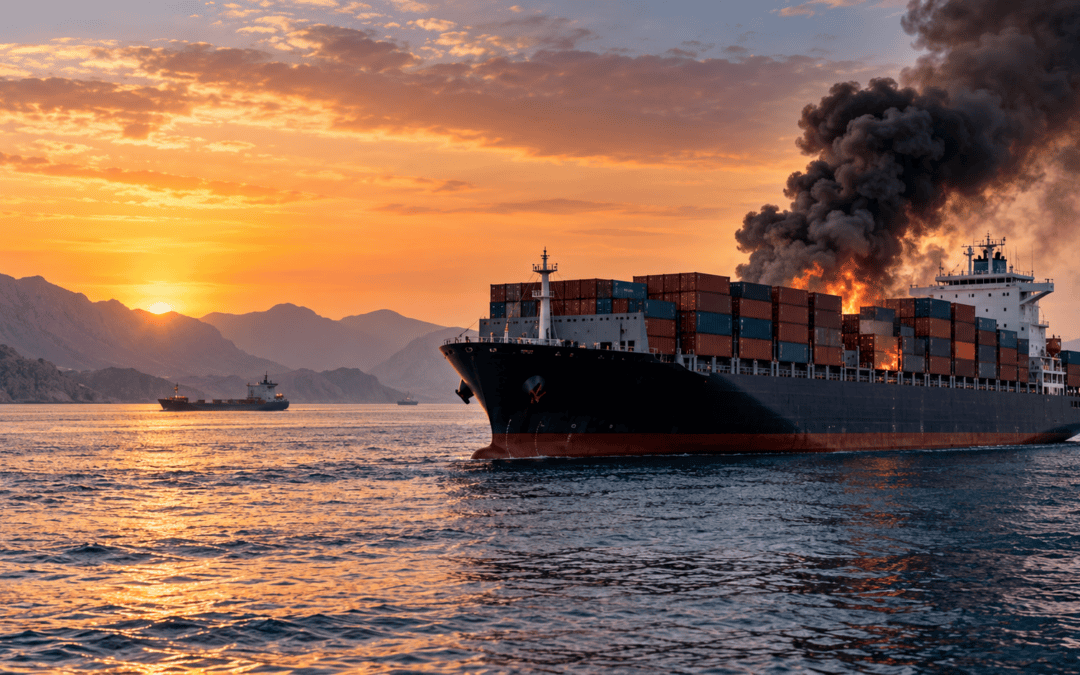
The sinking of the Singapore-flagged container ship GFS Pride in the Strait of Hormuz on October 13, 2026, is another reminder that international shipping carries risks that extend well beyond vessel schedules and freight rates. According to Singapore’s Maritime and Port Authority, the vessel was struck by an unknown projectile while transiting the strait. A fire broke out, and the ship subsequently sank. All 21 crew members were safely evacuated, and no injuries were reported. The Maritime and Port Authority of Singapore confirmed the incident the following day.
While the safe evacuation of the crew is welcome news, the incident raises serious questions for businesses with cargo moving through regions affected by geopolitical conflict:
- What happens when a commercial vessel is lost?
- Who is responsible for the cargo?
- Does insurance cover the loss?
- What can importers and exporters do to protect their businesses when established shipping routes become unsafe?
For companies involved in international trade, understanding these risks is an important part of supply chain planning.
When a Commercial Vessel Is Lost, What Happens to the Cargo?
A vessel casualty can have consequences that extend far beyond the ship itself. The GFS Pride was reportedly carrying more than 2,500 containers when it sank, although the full extent of cargo loss and damage has not yet been confirmed. Casualty information published by WK Webster highlights the uncertainty surrounding the condition and location of cargo following the sinking.
For cargo owners, a vessel loss can mean much more than a delayed delivery. Depending on the circumstances, goods may be destroyed, damaged by fire or seawater, lost at sea, or become subject to recovery and salvage operations. Even cargo that is not physically damaged may face complications. Salvage operations, recovery costs, and general average declarations can create additional financial and administrative obligations for cargo interests.
General average is a maritime principle under which certain extraordinary expenses or sacrifices are made to preserve a vessel, and its cargo may be shared among the parties with financial interests in the voyage. In some circumstances, cargo owners may need to provide a financial guarantee or security before their goods are released.
The important point is that a vessel casualty can create financial exposure even when a shipment is not an obvious total loss.
Marine Cargo Insurance Is Not the Same as Carrier Liability
One of the most important distinctions for importers and exporters to understand is the difference between carrier liability and marine cargo insurance. A bill of lading establishes important terms governing the transportation of goods, including aspects of the carrier’s responsibilities. However, carrier liability is not necessarily equal to the full commercial value of the cargo.
Depending on the applicable law, contractual terms, and circumstances of the loss, a carrier may have defenses or benefit from limits on its liability. A cargo owner may therefore recover considerably less than the value of the goods—or may not be entitled to compensation from the carrier at all.
Marine cargo insurance serves a different purpose. It’s designed to protect the financial interest of the party insured against covered loss or damage to goods during transit, subject to the policy’s terms, conditions, exclusions, and limits. The International Union of Marine Insurance’s Guide to Marine Cargo Insurance explains why relying solely on carrier recovery is not an adequate substitute for cargo insurance.
Businesses shipping through areas affected by geopolitical conflict should pay particular attention to war-risk provisions. War and related risks may be excluded from standard cargo coverage or require additional coverage, depending on the policy.
Coverage should never be assumed simply because a shipment is insured. Importers and exporters should review their policies with their insurance brokers to understand exactly what is covered, what is excluded, and whether additional protection is necessary for specific routes or voyages.
Who’s Responsible When a Shipment Is Disrupted?
When cargo is lost or a shipment cannot reach its intended destination, responsibility can become complicated. The answer depends on several factors, including the sales agreement, the agreed Incoterms® rule, the transportation contract, insurance arrangements, and applicable law.
Incoterms rules help define the responsibilities of buyers and sellers, including when risk transfers from one party to another. However, they do not determine every aspect of ownership, insurance coverage, or liability. For example, under some trade terms, risk transfers to the buyer when goods are handed to the carrier at the point of origin. Under others, the seller retains responsibility for certain transportation risks until a later point in the journey. This is important to note when a vessel is lost at sea because the party financially exposed to the loss may not be the party that arranged the shipment or purchased the insurance.
Importers and exporters should understand their contractual responsibilities before cargo moves, including who’s responsible for arranging insurance and what happens if a shipment is delayed, diverted, or lost.
What Should Cargo Owners Do When a Vessel Is Lost?
When a vessel casualty occurs, acting quickly and preserving accurate documentation can make a significant difference in managing a potential claim. Businesses with cargo aboard an affected vessel should:
- Identify the shipment: Confirm the vessel name, voyage, bill of lading, container numbers, and cargo involved.
- Notify the appropriate parties: Contact the freight forwarder, insurance broker, insurer, and relevant suppliers or customers as soon as possible.
- Review insurance coverage: Confirm the policy’s terms, including war-risk provisions, exclusions, deductibles, and notification requirements.
- Preserve documentation: Keep commercial invoices, packing lists, bills of lading, insurance certificates, and relevant correspondence.
- Follow claims instructions: Work with the insurer and any appointed surveyors or claims representatives regarding evidence, recovery, salvage, and next steps.
Businesses should also avoid assuming that a claim is automatically covered or that the carrier will reimburse the full value of the shipment. Insurance policies and transportation contracts have specific requirements, and missing notification deadlines or documentation can complicate recovery.
Risk Management Starts Before the Shipment Moves
No importer or exporter can eliminate every risk associated with international shipping. Geopolitical events, security threats, and unexpected vessel casualties are difficult to predict and can quickly change the operating environment. Thankfully, businesses can take steps to understand and manage their exposure.
That starts with evaluating shipping routes and staying informed about security conditions that could affect vessel movements. It also means understanding available alternatives, considering the potential consequences of a diversion, and reviewing insurance arrangements before cargo is loaded.
For some businesses, contingency planning may involve evaluating alternative ports or carriers. For others, it may mean adjusting inventory levels, allowing additional time for shipments, or reviewing how much financial exposure is concentrated in a single voyage. These decisions are especially important for companies moving seasonal or time-sensitive products, where a shipment loss or extended disruption can affect customer commitments, production schedules, and revenue.
An experienced freight forwarder can help clients understand changing shipping conditions, evaluate available routing options, monitor shipments, and communicate when circumstances change. While a freight forwarder cannot eliminate geopolitical risk or guarantee that a vessel will reach its destination, having an informed logistics partner can help businesses make better decisions when disruptions occur.
Protecting Your Cargo Requires More than Tracking a Shipment
The sinking of the GFS Pride reminds us of an uncomfortable reality of international trade: Even established shipping routes can become dangerous, and the consequences of a vessel casualty can extend far beyond a delayed arrival.
For importers and exporters, protecting cargo means understanding more than transit times and freight costs. It means knowing who bears the risk, what insurance actually covers, how claims are handled, and what alternatives may be available when shipping conditions change.
At Cyclone Shipping, we believe effective freight management starts with preparation, communication, and an understanding of the challenges that can affect a shipment. We work with clients to monitor changing conditions, navigate disruptions, and make informed transportation decisions. Because while no one can predict every event at sea, businesses can take steps to be better prepared when the unexpected happens.
Learn more about how we can partner with your business.